Pages

Showing posts with label Shakespeare. Show all posts

Thursday, May 2, 2013

"It is the star to every wandering bark..."

July 25, 2009
"Sonnet 116"
(William Shakespeare)

Let me not to the marriage of true minds
Admit impediments; love is not love
Which alters when it alteration finds,
Or bends with the remover to remove.
O, no, it is an ever fixed mark
That looks on tempests and is never shaken;
It is the star to every wandering bark,
Whose worth's unknown, although his height be taken.
Love's not Time's fool, though rosy lips and cheeks
Within his bending sickle's compass come;
Love alters not with his brief hours and weeks,
But bears it out even to the edge of doom.
If this be error and upon me proved,
I never writ, not no man ever loved.


When Jeff and I were planning our wedding in the spring of 2009, we spent a lot of time with our wonderful pastor, talking about what we wanted to include in the ceremony that would best represent us. We had favorite hymns and had selected Bible verses, but I kept coming back to my desire to include a Shakespeare sonnet. Not only had Jeff and I met at the Shakespeare Theatre of New Jersey, but I also had "Sonnet 116" in mind already--one that so beautifully expressed what lasting love really is. Finally, we decided to include it, and my brother read it beautifully on July 25, 2009, at our wedding ceremony.

On that day, I thought we'd been through a lot. We'd faced difficult friendships, wrestled with financial concerns, made compromises as we learned what it was to be part of another family, and dealt with the disappointment of not getting jobs we so desperately wanted. As a result, when Ret read the sonnet, I proudly thought, "yes--our love has stood up to some tempests and will endure." It's not so much that I was wrong then but more that I was, perhaps, a bit naive. As my mum and dad would say, there were "rooms of life" back then that I just hadn't walked in yet--that I couldn't possibly imagine ever walking into, if I'm honest. 

Every spring, my freshmen present sonnets to the class, and we always include "Sonnet 116" in the packet. One of their tasks is to state the sonnet's central idea--to explain its meaning in a concise, clear sentence. This year, two of my favorites describing "our" sonnet were these:


"True love is pure and reliable. It is consistent."

"Love is something that will not waver under pressure."

Very little in our last 21 months has been consistent. Very little has been reliable. And the pressure has been constant. And yet, today, as I listened to my student explain the sonnet to her classmates, I was overwhelmed with gratitude as I realized that our love is pure. And reliable. And consistent. And unwavering. It has not bent or altered or shaken, even in the face of grief and trauma we never could have imagined. It has not changed with the passage of Time or been cut down by challenges.

One of my students described the speaker's tone in the final couplet as "smug." She noted how the speaker seems over-confident in what he's stating--so confident, in fact, that he's willing to wager that he's not a writer and men can't fall in love if what he says isn't true. And to that I say, "well played, sir."

There is no error in Shakespeare's words, if the love is steadfast and true. How blest I am to be part of a marriage bound together with that kind of love.


Wednesday, May 1, 2013

Just because you're going to LOVE these costumes...

I've been trying to think of some meaningful way to tie this post into my current path in life or to make some statement about the phenomenal man I'm married to or to reflect on how much I've grown in the past few months. However, here's the reality: I'm exhausted from rehearsals, I really just want to curl up on the sofa with a BLT and the kittens, and yet I still can't wait to share some Viola photos with you tonight!

So, here are a series of photos from last night's first costumed run-through! (Keep in mind--our production of Twelfth Night, while maintaining Shakespeare's language, is reset in the 1980s at the Illyrian Music Festival.)

Twelfth Night (of the Rude Mechanicals variety)

Viola and her identical--Shakespeare wasn't so into realistic biology--twin brother, Sebastian, 
are a well-known pop duo.

Viola (me) and Sebastian (Amy--who plays a smashing boy, if I do say so myself)
having a cuddly sibling moment backstage.
Upon stumbling upon the Illyrian Music Festival, Viola quickly realizes that she needs a disguise to avoid some excitable fans.
Me and the "rabid" fan who will quickly become my accomplice
A disguise is needed--and fast! The most logical choice? 

Perhaps an undercover roadie is a good idea.

One of my favorite lines in the show--and I'm not giving it away yet
(though Lauren's reaction in the background tells you how fabulous it is!)
The seemingly excellent plan deteriorates as Viola realizes that, 
in imitating her own brother in her disguise, 

she has created such a believable boy that the famous star, Olivia, has fallen for her!

The lovely Olivia (played by the fabulous Lauren), throwing herself at me...
But can you blame her? I mean, check out those legs in those liquid gold leggings!


And so, as more cases of mistaken identity occur by the minute...
Silly Antonio--he thinks I'm a boy!

 The mayhem ensues...


Tuesday, February 26, 2013

"O!"

A (fairly typical) page from the "text work" section of my script
It's one of my favorite words in Shakespeare--the infamous "O" that leads off speeches like the Chorus's Prologue to Henry V. When I introduce Shakespeare to my freshmen, we play the "O Game." Students stand in a circle around me, and I give them only one rule: no matter what I tell them, the only word they have at their disposal is that all-purpose "O." We then wind our way through several scenarios: I bring them a little fluffy puppy to snuggle; I tell them that they get to go to their favorite restaurant for dinner tonight; they watch a prom proposal result in a "no" in a public location on campus; they smell raw sewage from a pipe break while on their drives home. Each "O" becomes its own unique language, and the students start to realize the inflections, intonations, and impulses that can affect how an actor chooses to use the word.

As a result, when I came across an "O" while in rehearsals for act 3, scene 4, of Twelfth Night last night, I realized that I had some choices. In the asides in question (the ones pictured above), I've just realized that there's a very real chance my twin brother, Sebastian, survived the shipwreck at the start of the play; in fact, it seems, I've been mistaken for him by another sailor. At the start of rehearsal, I struggled with the speeches; I seemed to be playing them as a single note, and I had no idea how to employ that "O" in the second to last line to its best possible use. Throughout a 45-minute period, my director coaxed me into a clearer understanding of the meaning; she encouraged me to take her on Viola's journey of discovery rather than just assuming I understood the implications of hearing Sebastian's name from the start. As I worked through the speech one more time, I was surprised to realize that this "O" was not a moment of wishful thinking; it was, instead, a moment of hopeful surety--though I don't know how Sebastian will be returned to me, I finally think it's quite possible that he will be.

And so I left rehearsal wondering if I could use "O" as a barometer for my own life. How often do I assume that my level of exhaustion will result in an "ugh" kind of "O" class rather than an "O!" one? How readily do I defeat myself before starting a run with an "O(h well)" rather than an "O(kay!)"? And when was the last time I really thought "O!" (we will have a family one day) rather than "O?" (there's another inevitable setback in our journey?

Today, I'm putting "O" on the table and letting it lead me where it will. I wonder what discoveries I'll make along the way.

Sunday, February 10, 2013

The Knot

While I've always loved Twelfth Night's Viola, one of her best-known monologues was destroyed for me years ago when virtually every girl was using it for any Shakespeare audition. The famous rhyming couplet that ends the speech is this:

O time! Thou must untangle this, not I;
It is too hard a knot for me to untie!

What resonance those words have for me today, and what a shock that they will be my own when I start rehearsals for Viola early next week. But, to understand why I needed such untangling, you must first understand the knot.

When we had our second miscarriage in December, my world didn't fall apart as I expected it to. I was sad, but this was something we'd been through before. I had no expectations that my cycle would return quickly or that we'd even have the emotional, financial, or mental stamina to dive back into medicated treatment cycles. Once we learned that the next step of the process would be extensive bloodwork (called an "RPL"--or Recurrent Pregnancy Loss--panel), it was almost as if the timeline was out of my hands. And so I stopped counting how many weeks it had been since the D&C or what month might be a possible new due date.

Over the next month or so, I stopped posting on my online support board as regularly as I used to, not because I don't love the amazing women there, but simply because getting pregnant wasn't able to be the thing I focused on the most. I continued to "mentor" two women--one a colleague and one a friend from church--as they went through infertility testing, treatments, and disappointments, but talking to them no longer felt competitive, like I had to get pregnant before them. Slowly I realized that I wasn't trying to make myself focus on things other than starting a family, I just was.

After many consultations with my amazing doctor, my patient therapist, and my ever-supportive husband, I came to a realization: the only reason I felt frantic about getting pregnant as soon as possible was because of my age. Once my doctor took that off the table (the fact that I turn 36 in May is not medically related--at least in any way we can tell--to our difficulty getting pregnant or sustaining pregnancy), a weight came off my shoulders. And then I began to think: what are all the things Jeff and I haven't done in the last year because our lives have been centered around testing and treatments?

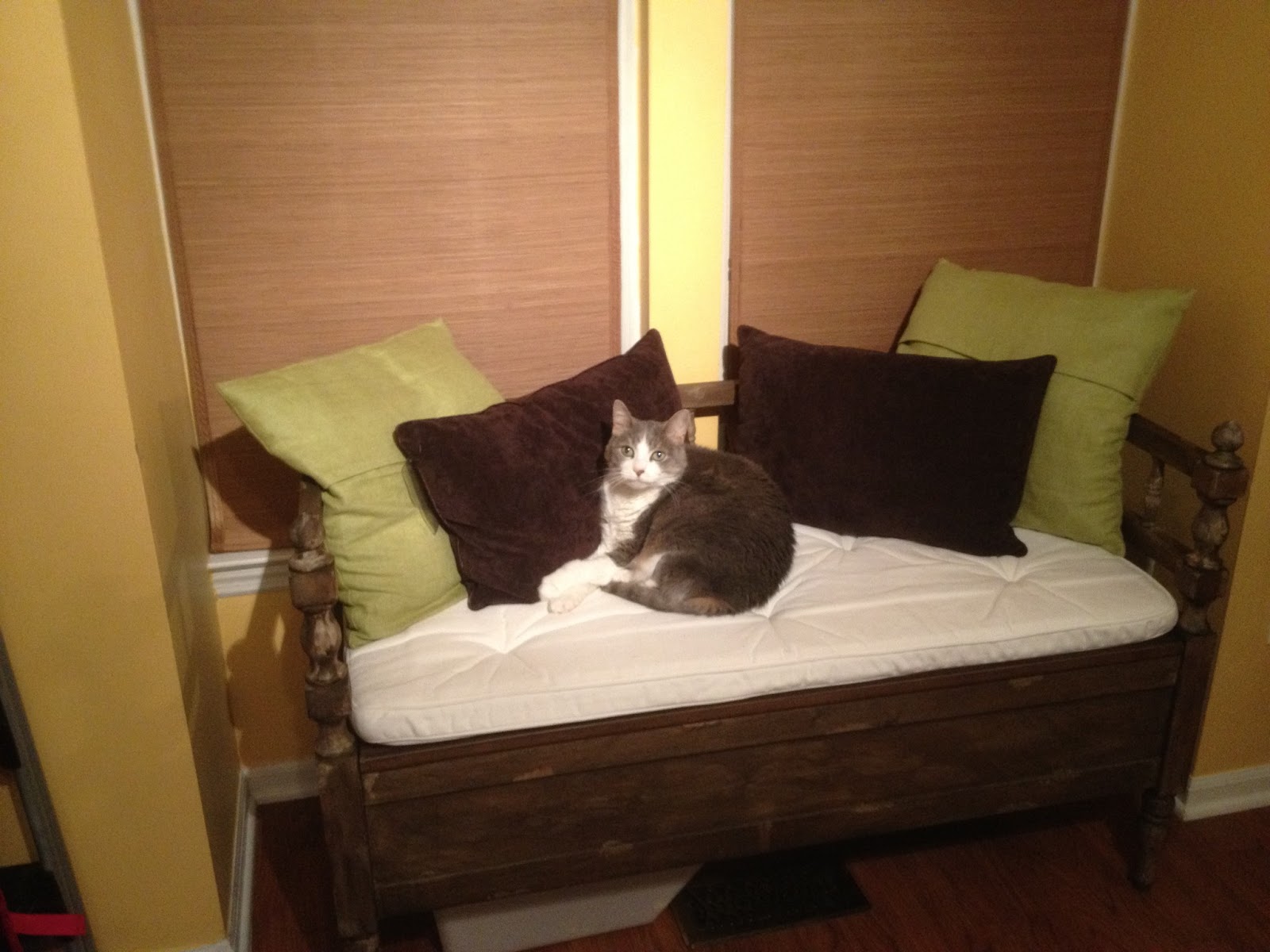
Realization 1: We moved into our house over a year ago, yet we haven't bought a single piece of furniture for the inside of it (we did buy a beautiful set for our deck for long summer evenings with friends). We were blessed, several years ago, with incredible family furniture through a few different sources, so we haven't needed anything, but this isn't about need. So, we perked up our kitchen last weekend by buying a cute little bench for our bay window and a much-needed spice rack for the wall.

Apparently, Guillie believes the bench was made for her comfort while we cook.
The first time our friends sit on it, it will be a rude awakening!

Our beautiful new spice rack--there's now a whole kitchen cupboard free!
Realization 2: Jeff is doing amazing things at work, and I want to support and encourage him as much as I can. His latest endeavor is a hybrid improv comedy / open mic night with a group of high school students that he helps direct at work. Their opening night is Thursday, February 14, and I can't imagine a more romantic Valentine's than seeing my talented husband doing what he loves.

"Code 20" is a nod to "Radio Channel 1020":
NYFD fire code referring to "Proceed to Fire." This will be exciting stuff!

Realization 3: I haven't done community theatre in four years, and I miss being on stage. To try to rehearse a show and develop a character while doing monitoring appointments, needing nightly shots, and scheduling last-minute IUIs would be nearly impossible; however, with those conflicts off the table, I decided to head into the world of auditions again. I found three of particular interest: Shakespeare's Twelfth Night, Shakespeare's Romeo and Juliet, and Neil Simon's Rumors. Having not auditioned in so long, my expectations were low but my standards were high: if I wasn't offered Viola or Olivia (Twelfth Night), Benvolio or Lady Capulet (Romeo and Juliet), or Chris or Cassie (Rumors), I wasn't interested. Much to my delight, I received callbacks for the first two auditions I attended (the Shakespeare plays). And then, yesterday afternoon, much to my shock, I was offered both Viola and Benvolio. After hours of deliberations and many talks with good friends, I decided that--in spite of the long commute to rehearsals--there was no way I could turn down the dream of Viola, especially when it's with an exclusively classical-with-an-edge community theatre that's well known in the DC-metro area.

Our Twelfth Night theme: set in the 1980s, Orsino and Olivia are in dueling bands.
And so, I think, I've finally untied the knot. Until Twelfth Night opens in early May, I'll be completely engaged in that process. It doesn't mean that Jeff and I don't still long to be parents, but it means that we're working on our own loves for a little while--both individually and together--so that we can pass on the importance of pursuing our passions to our own family one day.

Viola's right: untangling the knot just took a little time.

To my dear friends reading this who haven't heard from me in a bit: I'm clearly still here! :-) Email anytime and know that all my love and support is still coming to each of you.

Saturday, January 26, 2013

Fooling Around

The front page of Robert Armin's Foole upon Foole, written in 1600

When Robert Armin, an actor from Shakespeare's own company, wrote Foole upon Foole in 1600, he was bringing personal experience to the page. Since 1598, he'd been developing the roles of key fools in Shakespeare's plays, such as Touchstone in As You Like It. Though Armin's text refers to six kinds of fools, there were two that most Shakespearean scholars will agree are prominent: the artificial fool and the natural fool. About those two types, Armin said the following:

Natural Fools are prone to self-conceit;
Fools artificial with their wits lay wait
To make themselves Fools, liking the disguise
To feed their own minds and the gazer’s eyes.

Essentially, the distinction is this: the natural fool incites his betters to raucous laughter because the fool himself doesn't know any better, while the artificial fool studies his art to learn how to amuse his master while also exposing the master's shortcomings and often teaching a lesson. When I first introduced this idea to my senior elective students this week, we came up with examples from current media; John Stewart serves as an apt example of an artificial fool who uses humor to reveal truth while someone like Robin Williams, perhaps, is solely there to amuse us without a larger message in mind. Though my class will begin reading As You Like It next week, they haven't yet encountered Touchstone, Jaques, or William (all of whom are notable fools in that play), so I was finding myself at a loss to offer more examples to clarify the understanding of the somewhat perplexed students before me. 

And then, like the proverbial lightning bolt, it struck me: the cats.

Earlier in my teaching career, I used to tell stories about my cats all the time; when I taught at boarding school, they'd sometimes even show up for class themselves, perching on the windowsill after having stealthily stalked me all the way from my apartment across campus. Now that I'm in my thirteenth year of teaching, though, my stories have become far more erudite; no longer do I discuss silly cats, as I've moved on to my equally silly husband and our adventures together. However, when Rosie's furry little face popped into my mind during the discussion on fools, I couldn't resist.

The first stage was simply to admit that our three cats--Rosencrantz, Guildenstern, and Osric--are indeed named after characters in Shakespeare's tragedy, Hamlet. (In fact, I might argue that all three are natural fools, unwittingly bringing humor to dark moments in the play, but that's a topic for another post.) After my students had processed this information--with some good-natured teasing thrown in, of course--I used my clearest, most logical tone to explain my comparison. Rosie--our little furball who not infrequently walks off the back of the sofa, not realizing the end of a tangible support is imminent--is a clear example of a natural fool. Ozzy, on the other hand, is our little artificial dude, the one who studies the world around him closely, then attacks his sisters by using their own tricks against them. 

Rosie, surfing away on a clearly precarious wave of boxes, much to our amusement.

Ozzy, dutifully studying the world outside to learn from the lightning-quick machinations
of the kamikaze squirrel who regularly throws himself at our window.

I'm not sure how much I helped my seniors, except for arming them with the knowledge that their new English teacher may very well be a headed for a future as a crazy cat lady. However, when I told the story to Jeff over dinner that night, he took such delight in his eccentric and fur-covered wife that he made me promise to blog about it.

You thought this was going to be an esoteric post, didn't you? Nope--I'm just fooling around.

Ozzy, studying from the best: Twelfth Night's Feste.

Tuesday, April 10, 2012

Thou hast cleft my heart in twain.

Cleft. At first glance, I knew the word was the past tense of "to cleave," so I went to Merriam-Webster for a bit more enlightenment. The second definition in the list was the one that I expected: "to divide by or as if by a cutting blow." It's the meaning Gertrude intends in act 4 of Hamlet, and it's the meaning that my heart intended this morning when I woke up thinking the words. I wanted to remember the tiny Blueberry who broke my heart in two, to sit in the sorrow and grief of still not being able to try again, to rage against those who carry little ones in their bellies and in their arms.

But then, quite unexpectedly, I found the primary definition of cleave: "to adhere firmly and closely or loyally and unwaveringly." Of course--in the Book of Ruth, Ruth cleaves to her mother-in-law, Naomi, saying, "Don't urge me to leave you or to turn back from you. Where you go I will go and where you stay I will stay" (Ruth 1:16). What does it mean if, instead of breaking my heart in two, our little Blueberry actually glued it back together? How possibly could carrying that little life with me wherever I go for the remainder of my days in some way bring me renewed life and hope?

I'm not certain of the answers yet, but, after musing on this line for the better part of a day, I am certain of one thing: I will forever cleave to the little one who cleft my heart in twain.

Saturday, April 7, 2012

Exit, pursued by a bear.

In act 3 of Shakespeare's The Winter's Tale, a lord named Antigonus is tasked with the despicable job of leaving the newly born princess, Perdita, in the midst of the Bohemian woods. Believe it or not, this fate is actually preferable to the one she had before Antigonus and his wife, Paulina, intervened on her behalf; at first, her own father, the king of Sicilia, dictated that the infant should be burned alive.

Today, Jeff and I saw a touring production of the play by the American Shakespeare Center (ASC). I found myself so wrapped up in the emotional story that I nearly forgot that Shakespeare's most infamous stage direction would have to be played out at some point: Exit, pursued by a bear. While other productions have ranged from the comic (a teddy bear) to the mysterious (lighting and sound effects), ASC tackled the "problem" head on. As Antigonus laid Perdita on the ground in a basket, uttering the words, "Weep I cannot,  / But my heart bleeds," a bear entered from behind the upstage right curtain. Yes, it was an actor with a bear's head, but the impact was no less terrifying for that fact; I felt immediate concern for Perdita's safety and wished I, myself, could reach out and carry her home.

And then Antigonus did something I didn't expect. See, I don't like Antigonus very much. In spite of his earlier promise to "pawn the little blood which I have left / To save the innocent," he's all too willing to save his own skin by following Leontes's orders and leaving little Perdita alone at the mercy of the woods. Yet ASC's Antigonus did something shocking and totally unexpected: he saw the bear coming, quickly assessed Perdita's chances should the animal reach her, and boldly clapped his hands, drawing the bear's attention to himself. And then he exited, pursued by the bear that would take his life.

What a noble man! He sacrificed himself for the marginal chance at life for the sweet babe, yet he wouldn't break the oath he'd made to his king, no matter how disgusting he found that promise to be. In one moment, the Antigonus I'd hated became a man I admired, and he did so because he acted based on both instinct and loyalty, not on on intellectual consideration of his options.

Yesterday was Good Friday, when God made the greatest sacrifice imaginable for us: the life of his Son. Tomorrow, we'll celebrate the birth of new life in His resurrection. Like Perdita, who only survived because of Antigonus's sacrifice, I am only alive because a Sacrifice was made for my life.

I hope it doesn't take a bear for me to learn how to abandon my own needs and desires so selflessly.

Sunday, March 11, 2012

A Brief Acting Lesson

"The Representational actor deliberately chooses to imitate or illustrate the character's behavior. The Presentational actor attempts to reveal human behavior through a use of himself, through an understanding of himself and consequently an understanding of the character he is portraying. The Representational actor finds a form based on an objective result for the character, which he then carefully watches as he executes it. The Presentational actor trusts that a form will result from identification with the character and the discovery of his character's actions, and works on stage for a moment-to-moment subjective experience."
- Uta Hagen, Respect for Acting

I first read Uta Hagen's seminal text on acting as a sophomore at Davidson College. At the time, I loved her description of the Presentational actor; it seemed to promote a natural and spontaneous response on stage that I was often incapable of creating. Because of my love of organization, it was much easier for me to plan how to act rather than to live as a character. I strove to become Hagen's ideal actor--the one who would nightly respond to impulses and surprise myself with slight nuances in my performance.

Hagen's words have been coming back to me piece by piece in recent weeks, but never more strongly than in the past few days. As a result, I trekked down to the (somewhat still disorganized) basement family room Friday morning, pulled her book (off the neatly categorized and alphabetized) shelf, and found the words above. As I read, I was shocked to realize that the past eight weeks have changed me in a way that ten years of acting training never could; I have become a Presentational wife but a Representational teacher.

What I mean to say is this: while I would love to believe that I am a strong, mighty woman--and some days I truly am--I now do wear my emotions on my face and speak them in my voice. If I'm sad or angry or grumpy or tired, Jeff knows it. If I'm thinking about the baby or frustrated with a friend or anxious about a trip, I don't try to hide it from him. I admit when a negative home pregnancy test triggers a desire to exert control over my eating habits, and I spontaneously report "I feel pretty today" when I find that I do. As Hagen posits, in my personal life, I have started to understand myself and, in turn, to allow those discoveries to inform my behavior and actions. 

The classroom, though, is a different world for me; there I am the Representational teacher who decides to push through the day with a face crafted like a fragile porcelain vase, despite the tiny fissures just beneath the surface. It wasn't always like that; I used to bring my baggage into the classroom, allowing my own frustration and hurt to result in a short temper with my students. Now, though, being in the classroom is often a relief; it takes the focus off of me and allows me to assertively choose joy (at best) or normalcy (at worst)--at least on my exterior character.

This is the choice I made the day between learning of our lost Blueberry and entering the hospital for the D&C. I had every reason not to go to school that day, but I ignored them all. I cried between at least three different classes that day, with at least three different colleagues. And yet, in my classroom, watching the expectant faces of my students as they made new discoveries and as I reveled in their genuine exuberance, I found that Hagen, again, was correct when she asserted that "the Representational actor finds a form based on an objective result for the character, which he then carefully watches as he executes it." On that day, I watched joy come out of a choice to follow a form that I executed. I don't know what my students learned  on Thursday, January 12, but I am certain of what they taught me.

And so we come to the here and now. Just over eight weeks after my D&C, my body still not restored to rights, the game of Chutes and Ladders still precariously balanced, I am coming to learn that, as an actor chooses a new approach for each role, I can also choose a new approach for each day, each person, each situation. There is not a right and a wrong answer for all eternity; there is only today.

And today, I choose...